Today marks 25 years since Général Défao released his iconic album Nessy de London. Unlike his earlier works with his band Big Stars, the project was recorded entirely without them, as the group had disbanded after their US tour. Instead, Défao surrounded himself with a talented line-up of renowned session musicians, including Djudjuchet Luvengoka, Tabou Fakati Junior, Deese Mukangi, Nono Manzanza, Nyboma Canta, Roxy Tshimpaka, and 3615 Code Niawu, etc.Nessy de London is remembered not only as his final major success but also as a turning point in his career, as a long silence started until he returned with Nzombo le Soir in 2006.
Background;
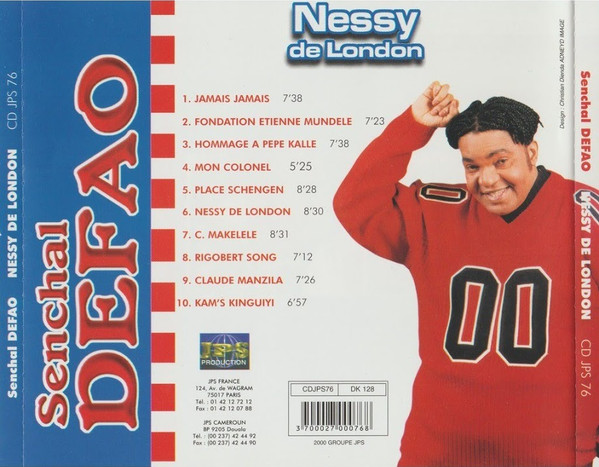
When Général Défao came to France in 1999 to mix his albums Guerre de 100 Ans and Bana Congo, there were already talks of an upcoming Europe tour and an event at Zenith de Paris. At the same time, Défao received a 10 years contract-offer to tour in the US and Canada. Défao chose to sign the contract for the US tour. He brought a part of Big Stars with him and they started touring while also performing concerts in the UK and Switzerland.
During the tour, preparations also began for a group album. However, problems started when Défao received a contract to tour in Uganda. This caused conflict between him and the musicians, who refused to go due to fears for their lives and families, believing that the trip could have dangerous consequences. They had all witnessed the Battle of Kinshasa in August 1998, when a coalition of Rwandan and Ugandan troops with Congolese mutineers tried to overthrow President Laurent Désiré Kabila, but were defeated by the Angolan and Zimbabwean forces, who helped the Congolese army out. Défao did not consider this a valid reason, thinking they were against the tour because they had not paid cars and that they would return straight away to Kinshasa. He tried to explain that they would return to the US after touring in Uganda, to finish the remaining tour dates.
Misunderstandings and mistrust grew, creating a tense atmosphere. Défao also believed that rivals were trying to destabilize his band and influence musicians to leave and join other groups. Band members tried to clarify the situation through donors and Defao’s family members, but it had no effect. At some point, Défao had enough and after performing in Lausanne, he decided to disband Big Stars by firing all the musicians who participated in the tour and went to London. Some of the same musicians followed him, hoping that he would change his mind.
Upon arriving in London, Défao was contacted by late Jean Pierre Saah, who wanted him to record an album under his label, JPS Production. They reached a verbal agreement. Défao then traveled alone to Uganda, joined by the musicians who had stayed in Nairobi, which became their new headquarter just before heading to the United States. After finishing the tour, Défao returned to France to sign the contract with Jean Pierre Saah for the Nessy de London-project and gave concerts in some cities, such as Luxembourg and Strasbourg, collaborating with session musicians as well as artists like Savanet Depitcho, JF Ifonge and Cesar Loboko.
Preparations;
During his stay in France, Général Défao made it clear in several interviews that he wanted to record his album Nessy de London with Reddy Amisi, Nyboma, Deese Mukangi and Roxy Tshimpaka. Sadly, Reddy Amisi could not participate, as he was preparing the duo album Fin d’Exil with Stino Mubi.
Before starting the recordings, Défao announced that from this album all songs dedicated to donors would only include their names in the song titles. This was meant to avoid disputes over to whom the songs were dedicated, as Congolese artists had started dedicating songs to multiple people, creating discontent among donors and sometimes even conflicts.
In Nessy de London, Défao dedicated songs to various donors and businessmen from the UK, Switzerland, Canada, and the USA. He also dedicated songs to soccer players Claude Makélélé (then playing for Real Madrid) and Rigobert Song (then playing for Liverpool), as well as to the restaurant Place Schengen of Bale Nyoyi. It was, and still is, rare to see Congolese artists dedicate songs to restaurants, barbershops and nightclubs. Additionally, Défao paid tribute to Pepe Kalle with the song ‘Hommage à Pepe Kalle,’ as his passing saddened many artists and music fans. Pepe Kalle was loved both for his personality and his musical talent.
When receiving money from JPS Production for the album Nessy de London, Défao bought four expensive jackets from Jitrois instead of using the money to purchase a villa in Binza Ma Campagne. Papa Wemba, who was seen as leader of the Sape movement, criticized him in private for this. It created a lot of polemique, many the Sape community saw it as marvelous. To this day, no other bandleader had done anything similar. Critics, however, viewed it as wasteful and foolish.
The album;
Reception;
Like the album Guerre de 100 ans, Nessy de London wasn’t promoted by Défao and himself also being absent from Kinshasa. Nevertheless, it was still a success in Kinshasa and its diaspora in Europe. On some Kinshasa music charts, it even reached number 2 as album. The song Nessy de London received a lot of airplay on radio stations and TV.
Aftermath;
A few months later, when Werrason released his album Kibuisa Mpimpa, some people debated whether it had originated from Nessy de London or even if it had been written by the same songwriter. More than 20 years later, Bogus Bompema revealed in various interviews, after having collaborated with Défao in Bana Congo on the song Battle Mathy, sung by the late Likinga Redo and Desouza Santu, that he had met Défao in Paris during the Fula-Ngenge trip with Papa Wemba. When they met, he sold Défao two songs (Nessy de London and Kams Kinguiyi) recorded on a cassette. He also said that a childhood friend, whose name he did’nt want to mention (Bourman Idolo), had stolen his song, modified the lyrics and sold it to Werrason, which the reason in his opinion the song has almost the same storyline.
One month after the release of Nessy de London, the VHS with the music videos was released. It became, after Werrason’s show at Bercy, the second best-selling video of the JPS label.
After finishing the recordings of Nessy de London, Défao ordered his staff in Kinshasa to bring the remaining musicians to Nairobi to join the rest of the band. At the same time, rumors spread that Défao would be arrested upon returning to Kinshasa for having performed in Uganda, which was at war with Congo at the time. These rumors only grew over the years as Défao did not return. Around 2007–08, the narrative shifted to a rumor that Joseph Kabila had been his car driver in Tanzania and that being the reason why Defao wasn't returning back to Kinshasa.
After staying in France, Défao went on a series of concerts in Angola, Botswana, Zimbabwe, and Kenya. It was in Kenya that problems began, as Défao and his musicians did not have work permits. The plan was to stay in Kenya and later travel to the U.S. once the tour promoter sorted out the visas. However, nothing materialized, leaving them stuck in Kenya. Numerous scandals arose, including Défao being arrested for unpaid hotel bills and his musicians encountering problems as well, with many leaving one by one.


